
 By
By Physicists have long sorted the universe’s fundamental building blocks into two neat categories: bosons and fermions. Now, a new theoretical breakthrough suggests that tidy division may be incomplete.
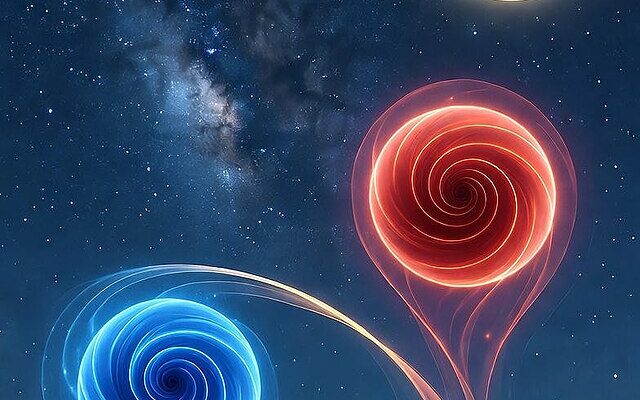
Researchers from the Okinawa Institute of Science and Technology and the University of Oklahoma report they have demonstrated the existence of so-called anyons in one-dimensional systems—extending what some physicists describe as a “third kingdom” of quantum particles beyond the traditional boson-fermion divide.
Their findings, published in two papers in Physical Review A, lay out the theoretical conditions under which anyons could emerge in a single spatial dimension and propose experimental setups—likely involving ultracold atoms—that could test the idea with existing technology.
In the three-dimensional world of everyday experience, elementary particles fall strictly into two classes based on spin and exchange behavior, explained Popular Mechanics. Bosons, such as photons and gluons, carry integer spin and can share the same quantum state. Fermions, including electrons and protons, possess half-integer spin and obey the Pauli exclusion principle, preventing identical particles from occupying the same state—a rule essential to the structure and stability of matter.
Anyons, first predicted in the 1970s, do not fit comfortably into either category. These quasiparticles exhibit fractional exchange statistics, meaning their behavior under particle exchange falls somewhere between that of bosons and fermions. They arise only in reduced dimensions, where particle paths can braid in ways that alter quantum phases.
Experimental confirmation of anyons first arrived in 2020, when researchers observed signatures of them in two-dimensional systems such as thin semiconductor layers. Until now, however, their existence had not been established in one dimension.
Professor Thomas Busch of OIST’s Quantum Systems Unit, a co-author on both papers, framed the work as a challenge to long-standing assumptions.
“Every particle in our universe seems to fit strictly into two categories: bosonic or fermionic. Why are there no others?” he stated. “With these works, we’ve now opened the door to improving our understanding of the fundamental properties of the quantum world and it’s very exciting to see where theoretical and experimental physics take us from here.”
Raúl Hidalgo-Sacoto, a Ph.D. student in Busch’s unit at OIST, explained why the boson-fermion restriction dominates in higher dimensions. In three dimensions, exchanging identical particles is mathematically equivalent to doing nothing. The exchange factor—a descriptor of that swap—must square to one, yielding only two possibilities: +1 for bosons or -1 for fermions.
Lower dimensions impose tighter constraints on particle motion. In such settings, trajectories cannot simply pass around one another; they are restricted in ways that allow continuous exchange factors between -1 and +1. Those intermediate values define anyons.
In one dimension, particles effectively must pass through each other because their motion is confined to a line. The interaction during that passage influences exchange statistics. The researchers showed that short-range interactions make it possible to create tunable anyons, with exchange factors adjustable by altering interaction strength. They also mapped how those exchange statistics would appear in observable quantities, including scattering behavior.
“We’ve identified not only the possibility of existence of one-dimensional anyons, but we’ve also shown how their exchange statistics can be mapped,” Busch added. “We’re thrilled to see what future discoveries are made in this area, and what it can tell us about the fundamental physics of our universe.”
The work builds on decades of theoretical exploration and the 2020 confirmation of two-dimensional anyons. If experimentalists can realize these one-dimensional versions, the results could deepen understanding of quantum statistics and open new pathways to studying exotic states of matter—an expansion not just of particle categories, but of the conceptual boundaries of quantum physics itself.