
 By admin
For more than 140 years, some of the world’s sharpest scientific minds have wrestled with a question involving a lawn sprinkler, a tank of water and a surprisingly stubborn bit of physics.
What happens when a sprinkler is submerged and water is sucked into its curved arms rather than sprayed out? Does it spin backward, forward or not at all?
Researchers at New York University now say they have the answer.
The submerged sprinkler does rotate, according to a study published Monday in the Proceedings of the National Academy of Sciences. It turns in the opposite direction from a conventional sprinkler, but at a considerably more leisurely pace.
“I am confident we’ve provided the experimental answer to the Feynman sprinkler problem,” said Leif Ristroph, the experimental physicist and applied mathematician who led the research.
The puzzle dates to 1883, writes The New York Times, when Austrian physicist Ernst Mach first described it. It later became known as Feynman’s sprinkler problem after Nobel Prize-winning physicist Richard Feynman recounted spirited arguments about it among Princeton graduate students during the 1940s.
Feynman also attempted to settle the matter experimentally. That effort ended with an explosion that sent glass and water across the laboratory — an exciting afternoon, perhaps, but not a definitive scientific result.
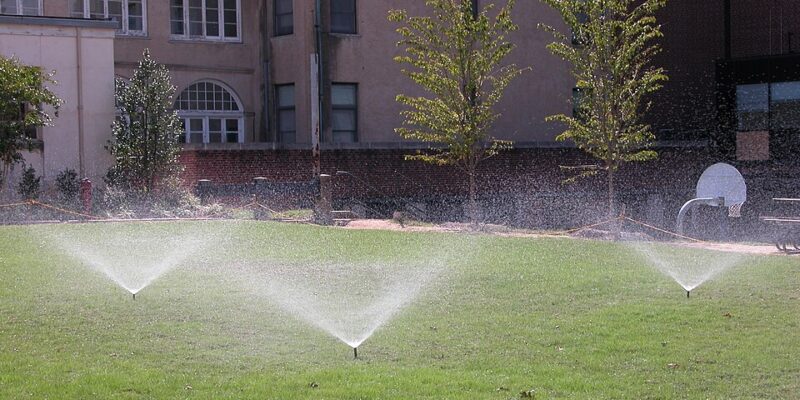
A conventional garden sprinkler is fairly easy to understand. Water shoots through angled nozzles at the ends of curved arms, creating thrust that pushes the arms in the opposite direction, much like the propulsion of a rocket.
Sucking water into the sprinkler produces a much more complicated interaction. For decades, theorists proposed competing explanations, while experiments frequently produced unclear or contradictory results.
Ristroph’s team reported two years ago that a reverse sprinkler rotates opposite the direction of an outward-spraying sprinkler, although at roughly one-fortieth the speed. The latest study reinforces that finding through additional experiments using modified versions of what the researchers call “silly sprinklers.”
In one test, the team added extra bends to the sprinkler arms so the inlets faced in the opposite direction. The alteration was designed to examine an explanation Feynman had considered — that suction might directly pull the arms around.
It did not.
The modified sprinkler continued to rotate in the same direction as the simpler S-shaped model.
“It does nothing like it, just didn’t matter,” Ristroph said of the extra bends. “The most important factor was the amount of bending near the pivot, because that determined the offset of the two incoming jets.”
The researchers concluded that the reverse rotation is caused by inertial forces acting on the incoming water as it travels around the curved arms. Those forces shift the two streams so they do not collide directly with one another, producing a small but measurable twisting force.
“If you’re a car and you’re turning right, you will feel a force, an inertial force, going in the opposite direction,” said Brennan Sprinkle, a co-author now at the Colorado School of Mines.
The earlier research did not immediately persuade everyone. Ristroph told the outlet that the team received substantial criticism, prompting the scientists to test additional sprinkler shapes and possible explanations.
Those new experiments, he said, make the competing theories “pretty definitively wrong from what we found.”
A submerged backward sprinkler is unlikely to become the next must-have lawn accessory. Still, researchers say the findings could improve scientists’ understanding of how solid objects interact with complicated fluid movements.