
 By
By Japan has brought online Asia’s first osmotic power plant in the coastal city of Fukuoka, marking a step forward in renewable energy technology that captures power from the natural mixing of fresh water and seawater.
The facility, integrated with a local desalination operation, is expected to produce approximately 880,000 kilowatt-hours of electricity annually. That output is enough to help power the adjacent desalination plant while supplying electricity roughly equivalent to the needs of about 220 households, writes The Guardian. Officials say the system benefits from a constant supply of seawater and freshwater, allowing it to generate power continuously and without dependence on weather conditions, unlike solar or wind installations.
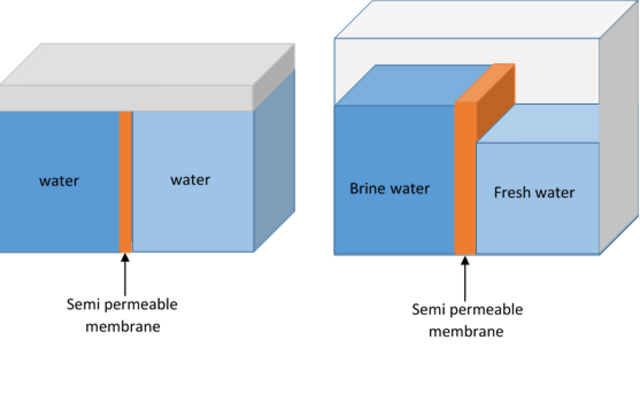
Osmotic power, sometimes referred to as “blue energy,” relies on the process of osmosis. In this configuration, treated wastewater or fresh water sits on one side of a specialized semi-permeable membrane, while highly saline water—often concentrated brine discharged from desalination—occupies the other. Water molecules move across the membrane toward the saltier side, creating pressure that drives a turbine to produce electricity. The plant in Fukuoka improves efficiency by using leftover brine, increasing the salinity gradient and the amount of energy that can be captured.
Kenji Hirokawa, director of the Seawater Desalination Center operating the site, described the project as “a meaningful plan—the start of a plan, perhaps—in our response against climate change.” He also emphasized its consistency, calling it “a stable source of electricity generation that can operate 24 hours a day, for every day of the year.”
The installation in Fukuoka is only the world’s second operational osmotic power plant, following a smaller facility that opened in Mariager in 2023. Japan’s version is reportedly larger. Earlier demonstration projects have appeared in countries including Norway, South Korea, and Spain, but most have remained at pilot scale due to technical and economic constraints.
Experts point to both promise and limitations. Professor Sandra Kentish, a chemical engineer at the University of Melbourne, noted the advantage of using concentrated brine but cautioned that significant energy is consumed by pumps and lost to friction across membranes, limiting net output. Akihiko Tanioka, professor emeritus at the Institute of Science Tokyo and a longtime researcher in the field, expressed optimism at the launch: “I feel overwhelmed that we have been able to put this into practical use. I hope it spreads not just in Japan, but across the world.”
Globally, osmotic power still accounts for only a small share of electricity production. Some estimates suggest that if challenges related to cost, membrane durability, and efficiency are addressed, the technology could contribute up to 15 percent of global energy demand by 2050, particularly in coastal regions and river estuaries where fresh and salt water meet.
For now, the Fukuoka plant represents a modest but practical milestone. By pairing osmotic generation with an existing desalination facility, operators convert waste brine into a usable resource, offering a model for integrating water treatment with energy production. While large-scale deployment remains uncertain, the project highlights growing interest in steady, low-carbon power sources that operate independently of sunlight or wind.