

 By
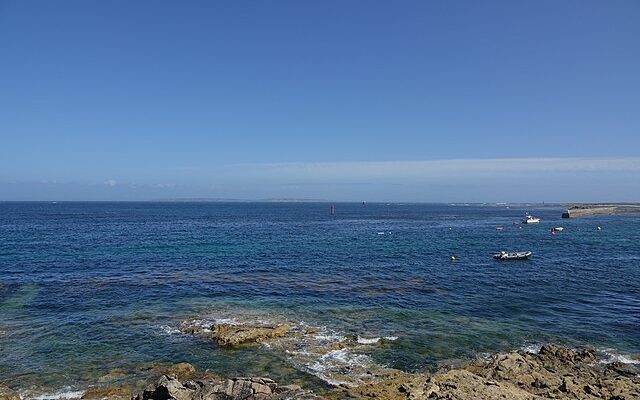
By French marine archaeologists have identified what may be the largest prehistoric underwater structure ever documented in France: a massive stone wall stretching 120 meters across the seabed nine meters below the surface near the Île de Sein, off the western tip of Brittany.
Scientific analysis places the construction at approximately 5000 BC, making it around 7,000 years old. Radiocarbon dating and geological evidence suggest the wall was originally built along an ancient shoreline, positioned between high and low tide during a period when the surrounding landmass extended far beyond the small island that exists today, writes Popular Mechanics.
"Un mur géant datant d’il y a 7 000 ans découvert sous 9 mètres d’eau au large de l’île de Sein"
>>> En archéologie, il faudrait systématiser les recherches sous-marines concernant les zones submergées après la fonte des calottes de l'ère glaciaire.https://t.co/8uxo7BRxkP pic.twitter.com/WwJT1IWu1z— Jacques Bolo (@JacquesBolo) December 11, 2025
The structure is formidable in scale. It averages 20 meters wide, stands roughly two meters high, and is estimated to weigh about 3,300 tonnes. Divers reported two parallel rows of large granite monoliths rising above the wall at regular intervals. According to researchers, these stones were placed directly onto bedrock first, with the wall later built up around them using slabs and smaller rocks.
Archaeologists believe the wall likely served one of two purposes. It may have functioned as an enormous fish trap, using retreating tides to funnel marine life, with the standing stones possibly supporting barriers made of woven branches. Alternatively, it could have been a defensive dyke designed to shield coastal settlements from encroaching seas as water levels rose after the last Ice Age.
“It was built by a very structured society of hunter-gatherers, of a kind that became sedentary when resources permitted. That or it was made by one of the Neolithic populations that arrived here around 5,000 BC,” said archaeologist Yvan Pailler, one of the project’s lead researchers.
The monoliths bear a striking resemblance to the famous menhirs scattered across Brittany’s landscape, though they predate them by centuries or more. Pailler believes this points to a possible transfer of stoneworking knowledge from local Mesolithic communities to incoming Neolithic farming groups, bridging two major phases of human development in the region.
The wall remained unnoticed until recently, when advances in seabed mapping revealed its outline. Local geologist Yves Fouquet spotted the anomaly while studying high-resolution radar-generated maps. “Just off Sein I saw this 120-metre line blocking off an undersea valley. It couldn’t be natural,” he told Le Monde newspaper.
Although initial dives took place in the summer of 2022, thick seasonal seaweed limited visibility. Detailed mapping only became possible the following winter, once the vegetation had died back and the structure could be properly examined.
In a newly published study in the International Journal of Nautical Archaeology, researchers argue that the wall may also shed light on Brittany’s enduring legends of lost coastal civilizations. They suggest that the sudden submersion of once-inhabited land left a deep cultural imprint, giving rise to myths such as the legendary city of Ys, said to have sunk beneath nearby Douarnenez Bay.
“It is likely that the abandonment of a territory developed by a highly structured society has become deeply rooted in people’s memories,” the paper states. “The submersion caused by the rapid rise in sea level, followed by the abandonment of fishing structures, protective works, and habitation sites, must have left a lasting impression.”
For archaeologists, the discovery offers a rare glimpse into how prehistoric societies adapted to dramatic environmental change—by engineering at a scale once thought impossible for communities so ancient, and by leaving behind traces that, even underwater, have endured for millennia.
[Read More: She Thought She Lost Everything Until She Heard The Tractors Start Up]