
 By
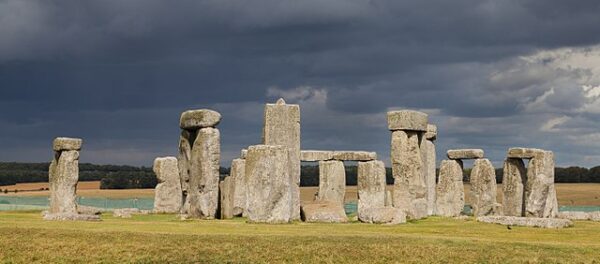
By For generations, scholars believed they understood the geological pedigree of one of Stonehenge’s most mysterious features. They were wrong.
A new study has upended long-held assumptions about the monument’s central Altar Stone, concluding that the massive slab did not originate in Wales, as previously thought, but in northeast Scotland — more than 450 miles from its resting place on Salisbury Plain.
The Altar Stone, a six-ton block of greenish Old Red Sandstone measuring roughly 16 feet by 3 feet, lies partially buried at the heart of the prehistoric complex in Wiltshire, southern England. For decades, experts traced its origins to the Brecon Beacons in southeast Wales, grouping it with other so-called “bluestones” transported from western Britain, writes Popular Mechanics.
But a research team led by scientists at Curtin University in Australia pursued a more exacting line of inquiry. Rather than relying on visual comparison or regional proximity, they analyzed microscopic mineral grains extracted from fragments of the stone, measuring their ages and chemical composition to establish what researchers describe as a geological “fingerprint.”
The results were striking.
“Our analysis found specific mineral grains in the Altar Stone are mostly between 1,000 to 2,000 million years old, while other minerals are around 450 million years old,” explained lead author Anthony Clarke, a Ph.D. student at Curtin’s Timescales of Mineral Systems Group. “This provides a distinct chemical fingerprint suggesting the stone came from rocks in the Orcadian Basin, Scotland, at least 750 kilometers [466 miles] away from Stonehenge.”
That mineral profile aligns closely with rock formations in the Orcadian Basin of northeast Scotland — and diverges sharply from Welsh geology. The findings, published in the journal Nature, effectively rule out the longstanding Welsh-origin theory.
Co-author Richard Bevins, a professor at Aberystwyth University, said the next phase of research will focus on narrowing the stone’s precise Scottish source. But even without that final pinpoint, the implications are profound.
Stonehenge dates to roughly 2600 BC. Transporting a shaped, six-ton stone across hundreds of miles during the Neolithic period would have required extraordinary coordination, planning, and technical ability. Overland movement from Scotland to southern England would have posed immense logistical challenges — terrain, rivers, forests, and sheer distance.
“Our discovery of the Altar Stone’s origins highlights a significant level of societal coordination during the Neolithic period and helps paint a fascinating picture of prehistoric Britain,” said co-author Chris Kirkland, a professor at Curtin. “Transporting such massive cargo overland from Scotland to southern England would have been extremely challenging, indicating a likely marine shipping route along the coast of Britain. This implies long-distance trade networks and a higher level of societal organization than is widely understood to have existed during the Neolithic period in Britain.”
If correct, that conclusion reframes Stonehenge not merely as an isolated ceremonial monument, but as evidence of a far-reaching network that linked distant communities across Britain thousands of years before recorded history. The Altar Stone, long assumed to be a product of nearer Welsh quarries, now points northward — toward a prehistoric Britain more connected, more capable, and more coordinated than previously imagined.