
Beauty

Astronauts Describe the Strange Smell of Outer Space

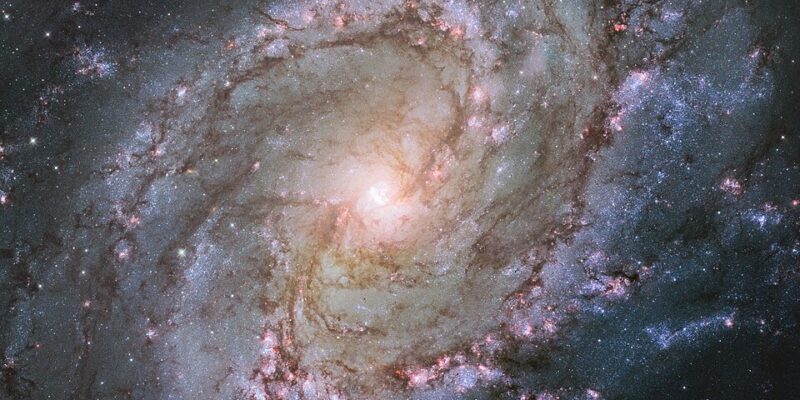
[Credit: NASA, ESA, and the Hubble Heritage Team (STScI/AURA)Acknowledgement: William Blair (Johns Hopkins University), Public domain, via Wikimedia Commons]

When most people imagine outer space, they think of distant stars, bright galaxies, and planets suspended in darkness. Few imagine a smell.

But astronauts who have returned from spacewalks say the cosmos leaves behind a distinct odor—one that clings to suits, tools, and equipment after they are brought back inside. Their descriptions are surprisingly earthly: metal, ozone, gunpowder, welding fumes, seared steak, even brake pads, writes Mental Floss.

Space itself is a vacuum, and astronauts cannot directly smell it while outside a spacecraft. But particles, radiation, gases, and chemical traces from the space environment can attach to equipment. Once that equipment returns to a pressurized cabin, the scent becomes noticeable.

The most common description is metallic. German astronaut Alexander Gerst once put it this way: “To me, space smells like a mixture between walnuts and the brake pads of my motorbike.”

Veteran astronaut Don Pettit offered an even fuller account: “It is hard to describe this smell; it is definitely not the olfactory equivalent of describing the palate sensations of some new food that ‘tastes like chicken.’ The best description I can come up with is metallic; a rather pleasant sweet metallic sensation. It reminded me of my college summers where I labored for many hours with an arc welding torch repairing heavy equipment for a small logging outfit. It reminded me of pleasant sweet-smelling welding fumes. That is the smell of space.”

Scientists have suggested several possible explanations for the smell.

One theory involves polycyclic aromatic hydrocarbons, or PAHs, a class of compounds found throughout the universe. On Earth, similar molecules are associated with burnt toast, charred meat, soot, and vehicle exhaust. In space, dying stars release carbon that can form sooty material rich in PAHs. Those particles may attach to astronauts’ suits and tools during spacewalks.

Another explanation involves ozone. Ultraviolet radiation can break oxygen molecules apart, leaving individual oxygen atoms to attach to surfaces. When those atoms later encounter ordinary oxygen, they can form ozone, which is known for its sharp metallic odor.

But the smell of space is not limited to one note. Other places in the universe may carry far stranger scents.

In 2014, the European Space Agency’s Rosetta probe analyzed Comet 67P/Churyumov-Gerasimenko and detected a mix of compounds associated with powerful smells, including hydrogen sulfide, which resembles rotten eggs; hydrogen cyanide, which has an almond-like odor but is highly toxic; ammonia, often compared to urine; and formaldehyde.

Dr. Louis Allamandola, former director of the NASA Ames Astrophysics and Astrochemistry Laboratory, described what some dense interstellar clouds might smell like: “Here, the space in dark clouds would smell a bit like a crazy ice cream shop with the crisp touch of water ice dominated by a breathtaking, knee-buckling ammonia whiff; in some cases with an additional morgue-like accent due to the formaldehyde.”

The Sagittarius B2 molecular cloud near the center of the Milky Way contains ethyl formate, the compound associated with the flavor of raspberries and a rum-like aroma. But the same region also contains dangerous chemicals, including propyl cyanide, making any romanticized vision of cosmic cocktails strictly theoretical.

Other parts of the solar system may have their own harsh signatures. Venus and Uranus likely carry rotten-egg odors because of sulfur compounds in their atmospheres. Mars, with its carbon dioxide-heavy atmosphere and traces of acids and sulfur, might have a sharp, dry, desert-like smell. Titan, Saturn’s largest moon, contains benzene and other hydrocarbons that could suggest a gasoline-like odor. Jupiter’s atmosphere, shaped by ammonia and phosphorus compounds, may carry notes closer to fuel, chemicals, or garlic.

The idea of space having a smell has even been brought back to Earth. In 2008, NASA asked chemist Steve Pearce to recreate the reported scent for astronaut training. Years later, a commercial version called Eau de Space was released after a crowdfunding campaign.

[Read More: Prehistoric Board Game Found]

What's your reaction?

Excited
0
Happy
1
In Love
0
Not Sure
0
Silly
0

You may also like

Leave a reply

Your email address will not be published. Required fields are marked *

More in:Beauty