
 By
By A team of archaeologists working in southern Spain has uncovered a remarkably well-preserved 5,000-year-old dolmen—a massive stone tomb dating to the prehistoric communities that once inhabited the Iberian Peninsula.
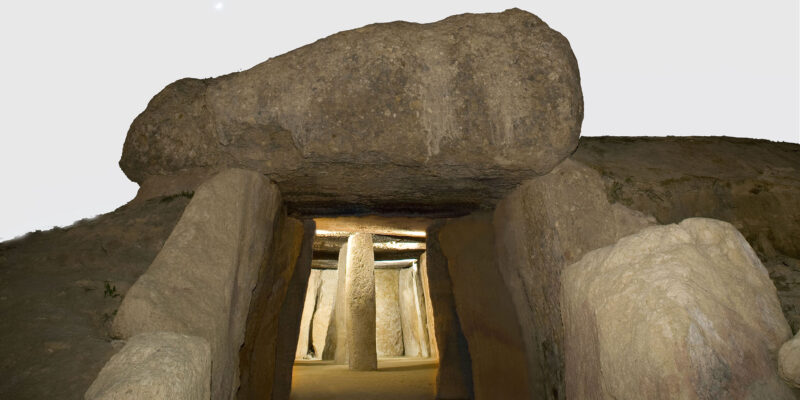
The structure, discovered at the La Lentejuela necropolis near the town of Teba in Málaga province, stretches roughly 42 feet in length and ranks among the most substantial megalithic tombs ever documented in the region. Excavations led by researchers from the University of Cádiz have revealed a carefully constructed burial chamber built from towering orthostat slabs—upright stones that rise more than six feet high and form a complex interior divided into multiple burial compartments, or ossuaries.
📢💣 ¡Descubren un espectacular dolmen!
El monumento funerario, conocido como Dolmen I se encuentra en la necrópolis de La Lentejuela (Teba, Málaga) y ha sido excavado durante cuatro campañas por la @univcadiz . Datado en el III milenio a.C., contiene osarios y ricos ajuares 🧵👇 pic.twitter.com/IyDkQWXHMB— César Dorado (@CDorado75) September 24, 2025
Archaeologists say the monument’s remarkable state of preservation offers an unusually clear glimpse into life and death in southern Iberia during the third millennium B.C., when early agricultural societies were developing increasingly complex social and ritual practices.
El Dolmen I contenía en su interior, además de los osarios, un rico ajuar de prestigio compuesto por piezas de ámbar, marfil y conchas marinas, así como piezas de sílex de gran calidad. Esto indica la existencia de redes comerciales de intercambio material a larga distancia. pic.twitter.com/aSSNt722th
— César Dorado (@CDorado75) September 24, 2025
“We could be talking about one of the most monumental and complete dolmens in all of Andalusia [the southernmost autonomous region of Spain],” Serafin Becerra, professor at the University of Cádiz, said in a translated statement from the school.
Project co-director Eduardo Vijande emphasized the research potential of the site, which appears to have remained largely intact despite the passage of millennia. “The true potential of this structure lies in its extraordinary state of conservation, which will allow us to gain a detailed understanding of the lifestyles and beliefs of these communities.”
Inside the tomb’s chambers, archaeologists uncovered human remains accompanied by a range of grave goods that suggest both ritual significance and long-distance connections with other regions. Among the artifacts were objects crafted from ivory, amber, and seashells—materials not native to the inland Málaga landscape.
The discovery hints at surprisingly extensive trade networks linking prehistoric communities to coastal and possibly international exchange routes. In addition to the exotic materials, the excavation team also recovered finely worked flint tools, including arrowheads, large cutting blades, and a particularly notable halberd—an axe-like weapon designed for two-handed use.
“The entire dolmen was also covered by horizontal large stone slabs, and on top of this covering, there was a tumulus [a human-made mound] of sand and small stones,” Eduarda Vijande Villa, an associated professor of prehistory at the University of Cádiz and co-director of the excavations, told Live Science.
The structure would originally have appeared as a low mound rising above the surrounding terrain, concealing the carefully arranged stone chamber beneath. Such tombs often served not only as burial sites but as visible monuments linking the living community to its ancestors.
Juan Jesús Cantillo, another professor at the University of Cádiz involved in the research, noted that some of the artifacts themselves reflect the symbolic importance of distant resources in prehistoric societies. “The presence of seashells in an inland area reflects the importance of the sea as an element of prestige and the existence of long-distance exchange networks.”
Dolmens—megalithic tombs built from massive stone slabs—were widely constructed across prehistoric Europe, particularly along the Atlantic seaboard from Iberia to the British Isles and Brittany. They typically functioned as communal burial spaces used over generations, suggesting tightly organized communities capable of coordinating large labor efforts.
The newly uncovered monument in Málaga adds another important example to that tradition. As excavations continue and researchers analyze the remains and artifacts recovered from the site, archaeologists hope the tomb will shed further light on the social structures, trade connections, and burial rituals of the ancient communities that built it some five millennia ago.